


The Complete Guide to Isopropyl Alcohol & Surgical Spirit

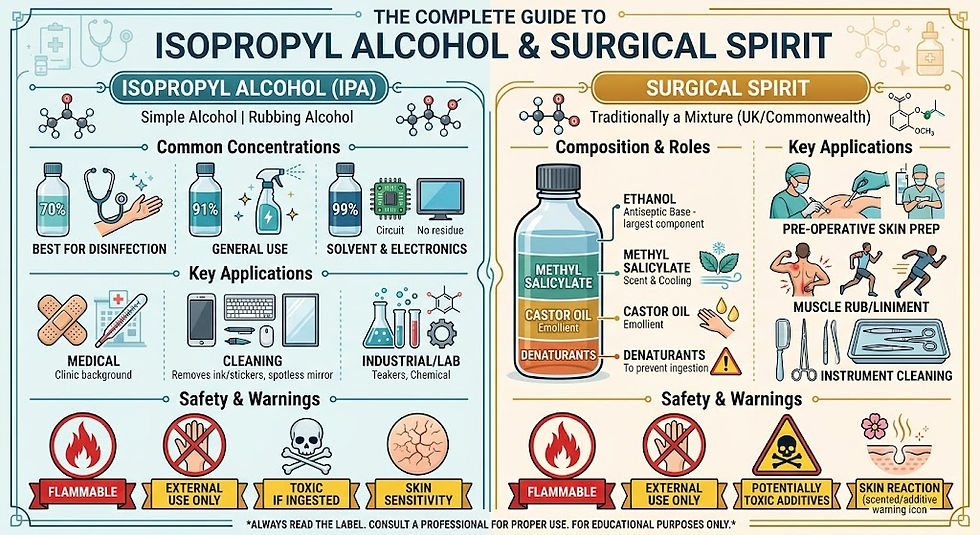
Isopropyl alcohol (IPA) and surgical spirit are two of the most widely-used solvent and disinfectant products on the Indian market. They overlap, but they are not the same product. This guide is for distributors, buyers, formulators, technicians and household users who need to understand what they are buying, what the differences mean in practice, and how to source the right grade for the job.
What isopropyl alcohol actually is
Isopropyl alcohol, also called isopropanol or 2-propanol, is a clear, colourless, volatile organic solvent with the chemical formula (CH₃)₂CHOH. It is miscible with water and a wide range of organic solvents. On the Indian market it is sold in two dominant concentrations — 70% (the disinfection standard) and 99% (the electronics / pharmaceutical / industrial cleaning standard).
It is one of the most common short-chain alcohols in industrial and clinical use, alongside ethanol. It evaporates fast, leaves no residue when pure, and disinfects effectively at the right concentration.
What surgical spirit is
Surgical spirit, on the Indian market, is a denatured ethanol or denatured ethanol-IPA blend used for topical disinfection. Historically the term came from British pharmacopoeial preparations where the base was ethanol denatured with methyl salicylate or methanol. In current Indian usage the term is loosely applied — some surgical spirit products are ethanol-based, some are IPA-based, and some are blends. Always read the label.
The key differences from pure IPA:
Surgical spirit often contains a denaturant or fragrance (methyl salicylate, oil of wintergreen) to discourage drinking.
It may contain water and emollients to reduce skin drying.
It is sold for topical / household disinfection, not for technical / industrial solvent use.
IPA 70% vs 99%: when each one is right
This is the single most-asked question in the category.
Property | IPA 70% | IPA 99% |
Disinfection of skin and surfaces | Yes — standard | Less effective in practice |
Electronics cleaning | Not ideal (water residue) | Yes — standard |
Drying time on skin | Slower | Very fast |
Evaporation residue | Minimal | None |
Flammability | High | Higher |
Typical buyer | Hospitals, clinics, salons | Electronics manufacturers, labs, pharma |
Why 70% disinfects better than 99% — counterintuitively.
Higher alcohol concentration is not better for disinfection. 70% is the standard because it offers the right balance:
Sufficient alcohol to denature microbial proteins.
Enough water to slow evaporation, giving the alcohol time to penetrate microbial cell walls.
Better penetration of microbial cell membranes compared to pure (99%) IPA, which dehydrates the outer cell wall so quickly that the alcohol cannot reach the cytoplasm.
So a 70% solution sitting on a skin patch for 30 seconds kills more microbes than a 99% solution that evaporates in 5 seconds.
Where each grade is used
IPA 70% — clinical and consumer disinfection:
Hand and skin wipe before injections / phlebotomy.
Surface wipe-down in clinics, salons, dental offices.
Hand sanitiser base.
Wipe-down of medical-device exteriors.
IPA 99% — technical and industrial use:
Cleaning electronics, optics, fibre optics, printed circuit boards.
Pharmaceutical and laboratory solvent.
Pre-cleaning of surfaces for adhesive bonding.
Cleaning of cleanroom and semiconductor surfaces.
Removing flux residue, light oils, fingerprints.
Surgical spirit — household and first-aid:
Wound prep and skin cleansing.
Sterilising thermometers, tweezers, small instruments.
Cleaning bedsores / pressure-point hygiene under nursing care.
Wipe-down of hard household surfaces.
Specifications a buyer should ask for
For IPA:
Assay (% by volume / mass).
Water content — particularly important for 99% IPA used in electronics.
Residue on evaporation — should be near zero for pharma / electronics use.
Specific gravity at 20°C.
Acidity / alkalinity.
Heavy metals for pharmacopoeial grades.
Microbial count for clinical SKUs.
For surgical spirit:
Stated base (ethanol-based, IPA-based, or blend).
Denaturant identity and concentration.
Net alcohol content.
Excipients (water, glycerine, oil of wintergreen, etc.).
Skin-irritancy data if relevant for the customer.
Methylated spirit vs surgical spirit vs IPA
This trio confuses buyers regularly.
Product | Base | Denaturant | Typical use |
Methylated spirit | Ethanol | Methanol (toxic) | Industrial / fuel / cleaning. Not for skin |
Surgical spirit | Ethanol or IPA | Less toxic denaturants | Topical disinfection |
IPA 70% | Isopropanol + water | None | Disinfection (skin and surface) |
IPA 99% | Isopropanol + minimal water | None | Electronics / industrial / pharma |
The practical buyer rule: ask for the specific product by name and read the label. The same generic word can label two different chemistries.
Safe handling and storage
Both IPA and surgical spirit are flammable solvents. Standard precautions:
Store in cool, well-ventilated areas, away from heat and ignition sources.
Keep containers tightly closed; vapour is denser than air and collects at floor level.
Bulk storage requires fire-rated cabinets or rooms; large volumes are regulated.
Use chemical-resistant gloves for prolonged contact (skin defatting otherwise).
No smoking, no open flames, no sparks near open containers.
Storage temperature should be well below the flash point — flash points for IPA are around 12°C (closed cup), so a warm storeroom puts vapour in the flammable range easily.
What not to use IPA / surgical spirit on
On open wounds for routine care — both sting badly and may damage healthy tissue. Saline is gentler for routine wound cleaning.
On painted surfaces — strip paint and finishes.
On natural rubber, certain plastics — solvent attack.
On polished wood — damage finish.
As an internal antiseptic / mouthwash — both are toxic if ingested in any quantity.
Choosing a supplier
For a distributor or industrial buyer:
Specify concentration (70% / 99% / other) and grade (technical, cosmetic, IP / USP).
Ask for COA per batch — assay, water content, residue on evaporation, heavy metals where relevant.
Confirm packaging: HDPE jerry cans for bulk, food-grade or pharma-grade containers for clinical SKUs.
Verify regulatory status — surgical spirit is a regulated product under Indian Drugs & Cosmetics rules for retail sale; check the supplier's licensing.
ISO 9001 at minimum; GMP for pharma-grade SKUs.
Confirm dangerous-goods compliance for transport.
Pricing benchmarks
Approximate Indian wholesale benchmarks (mid-2026; vary with feedstock and region) [VERIFY against current quote]:
SKU | Approx. wholesale ₹ per unit |
IPA 70% 500 ml | ₹100–160 |
IPA 99% 500 ml | ₹150–250 |
IPA 99% 5 L | ₹1,200–2,000 |
Surgical spirit 100 ml | ₹25–45 |
Surgical spirit 500 ml | ₹85–140 |
Pricing tracks the global ethylene / propylene feedstock market for IPA; surgical spirit pricing additionally tracks denaturant and excise / regulatory cost.
Distributor playbook
Stock IPA 70% in 500 ml and 5 L for clinical accounts; IPA 99% in 500 ml and 5 L for electronics, pharma, lab customers.
Stock surgical spirit in 100 ml and 500 ml for retail / pharmacy / household customers.
Train sales staff to clarify intended use before quoting — wrong grade is the #1 complaint in this category.
Audit incoming batches: clarity, smell, evaporation test on a clean glass plate for residue check.
Stock rotation: opened or short-dated IPA loses strength noticeably; rotate FIFO.
Pair with skincare add-ons (moisturiser, emollient) for high-volume clinical customers to manage skin-drying complaints.
Frequently asked questions
Is IPA the same as surgical spirit?
No. They overlap functionally but are different products. Surgical spirit on the Indian market is typically denatured ethanol or ethanol-IPA blend formulated for topical use; pure IPA (70% or 99%) is a single-chemistry product.
Which kills germs better, 70% or 99% IPA?
70% — for the counterintuitive reason that it stays wet on the surface longer and penetrates microbial cell walls better. 99% evaporates so fast it does not get full germicidal contact.
Can I clean electronics with 70% IPA?
Not ideal. The 30% water can corrode contacts, leave residue, and damage some components. Use 99% IPA for electronics; let it fully evaporate before powering up.
Is IPA safe on skin?
Yes for short, intermittent use as a disinfectant. Prolonged contact dries and defats skin; use moisturiser if you are wiping repeatedly all day.
Can I drink surgical spirit?
No. It contains denaturants that make it unsafe to drink — that is exactly the point of the denaturant. Ingestion can be fatal; treat any swallowing as a medical emergency.
What is the flash point of IPA?
Around 12°C (closed cup) for 99% IPA. This means it can give off flammable vapour at any normal room temperature. Treat as a flammable solvent.
How long does opened IPA stay effective?
Tightly capped and stored cool, opened IPA is effective for 12 months easily. Loosely capped or warm, it can lose strength faster as alcohol evaporates preferentially, leaving water-rich solution.
Pioma Chemtech, a specialty chemical manufacturer based in India, supplies isopropyl alcohol and surgical spirit in commercial pack sizes for industrial, clinical and institutional use. Contact us for grade-specific pricing and samples.


Comments