


Tincture Iodine Manufacturer & Wholesale Supplier in India

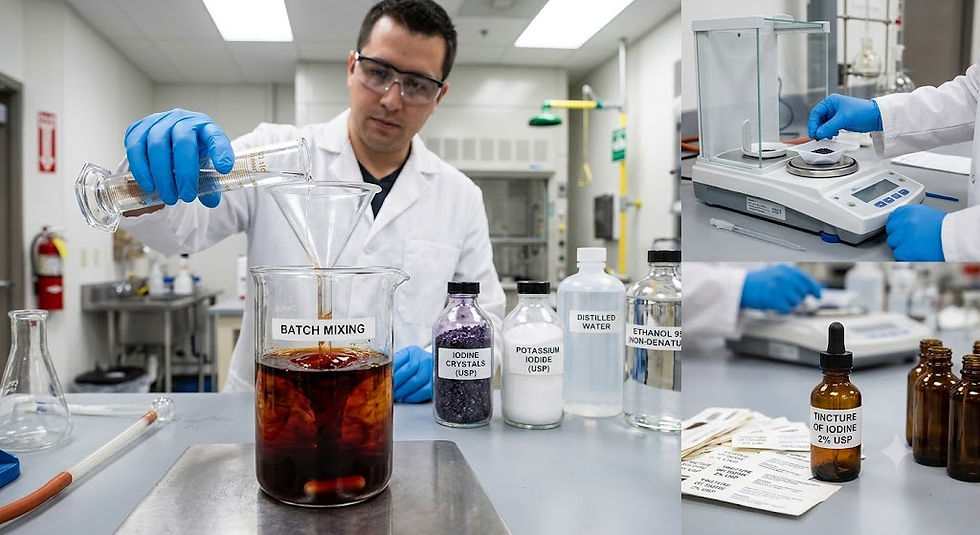
Tincture of iodine is an older, low-cost antiseptic still stocked in many Indian pharmacies and used in small clinics and field-medicine settings. Although newer antiseptics like povidone iodine and chlorhexidine have replaced it in most surgical pre-prep applications, tincture iodine retains a steady distributor-channel demand for first-aid kits, veterinary use, retail pharmacy stocking and small clinical centres. This guide covers what tincture iodine actually is, where it still fits, and how distributors should source it from Indian manufacturers.
Pioma Chemtech is a specialty chemical manufacturer based in India focused on adjacent products — 70% isopropyl alcohol, surgical spirit, hydrogen peroxide and hand sanitiser. This article is an educational sourcing guide for the tincture iodine market, not a sales document for our own catalogue.
What tincture of iodine actually is
Tincture iodine (per the Indian Pharmacopoeia) is a solution of free iodine (typically 2% w/v) and potassium iodide (~2.4% w/v) dissolved in an alcoholic vehicle, usually 50% v/v ethanol or industrial methylated spirit (IMS). The potassium iodide increases iodine solubility. The product is the deep-red-brown liquid familiar from first-aid kits across generations.
Two presentations exist:
Weak tincture (mild iodine tincture) — lower iodine concentration, less harsh on skin
Strong tincture — the classic 2–2.5% iodine + KI in alcohol; the standard pharmacopoeial product in India
Strong tincture is the standard medicinal-grade product distributors will stock.
Where tincture iodine still fits
Modern guidance generally prefers povidone iodine or chlorhexidine for surgical and clinical skin antisepsis, because tincture iodine:
Stings considerably more on broken skin (alcohol + iodine)
Stains skin and fabric more aggressively
Lacks the controlled release of povidone iodine
Has more potential to irritate
That said, tincture iodine continues to sell because:
Long shelf life and stability — properly stored, very long-lived
Familiarity — generations of users trust the product
Lower cost than povidone iodine for comparable iodine load
First-aid kits — included in many off-the-shelf kits
Veterinary and field use — robust and well-suited to non-clinical settings
Specific dermatological uses under medical guidance
Rural and small-clinic demand where price sensitivity dominates
Stocking pattern in 2026: pharmacies carry small bottles (15 ml, 30 ml), institutional buyers (small clinics, veterinary suppliers) take 100 ml and 500 ml.
Standards and grade
For human medicinal use, the right grade is IP (Indian Pharmacopoeia). The IP monograph specifies:
Iodine content within a defined range
Potassium iodide content
Alcohol content
Identification tests
Heavy-metal limits
Confirm IP compliance on the label and in the COA for every batch you buy. Lower-grade industrial or technical iodine tinctures exist for non-medical applications and should not be substituted for medicinal use.
Pack sizes and packaging
Typical commercial pack sizes:
15 ml and 30 ml — retail pharmacy
100 ml — small clinic, retail high-end
500 ml — institutional and small-clinic bulk
1 L — institutional bulk
5 L jerry cans — industrial/veterinary bulk
Container must be amber glass or amber HDPE — iodine degrades under light, and the alcohol base can stress unsuited plastics. Clear or thin-walled containers are warning signs. Closures should be tight, ideally induction-sealed for transit integrity, since the alcohol component creates vapour pressure variations during transport and storage.
Sourcing checklist
Before placing a first order with a new manufacturer:
Current manufacturing licence under the Drugs and Cosmetics Act
Recent COA showing IP compliance for the specific batch
ISO 9001 certification of the manufacturing facility
Alcohol source — ethanol vs IMS — declared and compliant with state excise rules
Labelling that meets Indian disinfectant/antiseptic labelling requirements
Stated shelf life (typically 24-36 months) and batch traceability
Confirmed MOQ and lead time — see MOQ and lead times
Returns and complaint-handling policy
References from current distributor customers in your region
Alcohol base — pay attention
The alcohol component is regulated separately. Manufacturers using ethanol need state excise licences; those using IMS need IMS-handling permits. A reputable manufacturer's documentation will reflect this. A vague answer about the alcohol source is a flag.
Storage and handling
Store below 25°C in original containers
Out of direct sunlight (UV accelerates iodine loss)
Keep away from open flame — the alcohol base is flammable
Tight closures essential — alcohol evaporation concentrates the iodine over time, changing the strength
Track shelf life via FEFO like other antiseptics
Pricing dynamics
Indicative 2026 wholesale ranges for IP tincture iodine (strong):
30 ml bottles, case lots: ₹8–18 per bottle
100 ml: ₹25–55 per bottle
500 ml: ₹90–220 per bottle
5 L jerry can: ₹650–1,400
Tincture iodine is meaningfully cheaper than povidone iodine on an iodine-equivalent basis, which sustains demand at the price-sensitive end of the market.
What buyers typically pair it with
A retail antiseptic shelf usually carries a mix:
Tincture iodine — first-aid kit segment, price-sensitive buyers, veterinary
Povidone iodine — mainstream medicinal use
70% IPA and surgical spirit — skin prep and surface decontamination
3% hydrogen peroxide — wound and mouth use
Chlorhexidine mouthwash and skin cleanser
Silver-sulfadiazine cream for burns
Frequently Asked Questions
Is tincture iodine the same as iodine solution?
No. Iodine solution (aqueous Lugol's-type) uses water as the vehicle. Tincture uses an alcohol base, which improves penetration of the iodine but increases stinging on broken skin.
Is tincture iodine still recommended for wounds?
It is suitable for intact skin prep before minor procedures, but for open cuts and wounds most modern guidance now prefers gentler options like povidone iodine, sterile saline irrigation or simple soap-and-water cleansing.
Why does tincture iodine sting so much?
Two reasons: alcohol on broken skin is irritating, and free iodine in the tincture is more aggressive than the controlled-release povidone iodine. The sting is short-lived but real.
How long does tincture iodine last on the shelf?
IP-grade product properly stored has a typical shelf life of 24–36 months. Discoloration, separation, or smell changes indicate degradation — replace.
Can I dilute tincture iodine?
Some applications use a weakened tincture, but adjusting concentration of a regulated medicinal product is not a routine retail decision. Use it at the labelled strength unless directed by a doctor or pharmacist.
Is tincture iodine safe for children?
Use under guidance of a doctor or pharmacist. The stinging, staining and alcohol content make it less suitable than gentler antiseptics for paediatric first aid.
Is tincture iodine flammable?
Yes — the alcohol vehicle is flammable. Store away from open flames and ignition sources. Standard distributor warehouse fire-safety protocols apply.
Tincture of iodine is a small but enduring product line. Buyers willing to stock and rotate it serve a real, price-sensitive segment that other antiseptics don't capture.
— Pioma Chemtech is a specialty chemical manufacturer based in India. Available for bulk and commercial supply of 70% IPA, surgical spirit, hydrogen peroxide and hand sanitiser — adjacent antiseptic-shelf chemistry.



Comments